
Originally Published By
Collaborative Divorce: Is It Right for You? | Expert Guide
View Original Article →Let’s face it – divorce is never easy, even when both parties are on relatively good terms. The emotional rollercoaster, the uncertainty about the future, and the potential for conflict can make it a daunting process. But here’s the thing: while you might not be able to salvage your marriage, you absolutely can choose how you want it to end. Enter collaborative divorce – a game-changer in the world of marital separation.
If you and your soon-to-be-ex are both willing to put aside the boxing gloves and work together toward a fair settlement, this approach could be your ticket to an amicable split. It’s like divorce mediation on steroids, offering a “no-court” solution that can save you time, money, and a whole lot of headaches. But is collaborative divorce the right path for you? Let’s dive in and explore this innovative approach to ending a marriage with dignity and mutual respect.
Table of Contents
What Is Collaborative Divorce?
Collaborative divorce is a unique and increasingly popular approach to ending a marriage that prioritizes cooperation over confrontation. Unlike traditional litigated divorces, which often pit spouses against each other in court, collaborative divorce focuses on problem-solving and mutual respect. This innovative process aims to resolve disputes and reach agreements outside of the courtroom.
Key Features of Collaborative Divorce
- No-Court Agreement: At the heart of collaborative divorce is a legally binding agreement signed by both spouses and their attorneys, committing to resolve all issues without going to court. This agreement incentivizes everyone to work toward a mutually beneficial solution.
- Team Approach: Collaborative divorce utilizes a team of professionals to guide the process:
- Collaborative attorneys for each spouse
- A neutral financial specialist
- A mental health professional acting as a divorce coach
- Child specialists (when children are involved)
- Open Communication: The process encourages transparent, honest communication between all parties. This openness fosters trust and facilitates more productive negotiations.
- Interest-Based Negotiation: Instead of positional bargaining, collaborative divorce focuses on identifying and addressing the underlying interests and needs of both parties.
- Customized Solutions: The flexibility of the collaborative process allows for creative problem-solving and tailored solutions that may not be available through traditional court proceedings.
- Privacy: Unlike court proceedings, which are typically public, collaborative divorce offers a higher degree of privacy for personal and financial matters.
The Collaborative Divorce Process

Understanding the steps involved in a collaborative divorce can help you feel more confident and prepared as you navigate this journey. While each case is unique, most collaborative divorces follow a similar path.
- Initial Consultation: Each spouse meets with their respective collaborative attorney to discuss the process and determine if it’s suitable for their situation.
- Signing the Participation Agreement: Both spouses and their attorneys sign the no-court agreement, committing to the collaborative process.
- Team Assembly: The couple, along with their attorneys, selects the other professionals needed for their collaborative team.
- Information Gathering: All relevant financial, personal, and child-related information is collected and shared transparently among the team.
- Joint Sessions: A series of meetings are held with the entire team to discuss issues, brainstorm solutions, and negotiate agreements.
- Separate Coaching Sessions: Individual sessions with the divorce coach help each spouse manage emotions and develop effective communication strategies.
- Draft Agreement: Once all issues are resolved, attorneys draft a comprehensive settlement agreement.
- Review and Signing: Both spouses review the agreement with their attorneys and sign the final document.
- Court Filing: While the spouses don’t attend court, the agreement is filed with the court to finalize the divorce legally.
Benefits of Collaborative Divorce
Choosing a collaborative approach to divorce offers numerous advantages over traditional litigation. These benefits can have a positive impact not only on the divorce process itself but also on your post-divorce life and relationships.
- Potentially lower cost compared to litigation
- Faster resolution than traditional court proceedings
- Reduced emotional stress for all family members
- Greater control over the outcome
- Preservation of co-parenting relationships
- Flexibility to address unique family situations
By choosing collaborative divorce, couples can navigate the challenging process of ending their marriage with dignity, respect, and a focus on long-term family well-being. This approach can be particularly beneficial for couples with children, as it sets a foundation for positive co-parenting relationships post-divorce.
The Collaborative Divorce Team: Your Support System

One of the unique aspects of collaborative divorce is the team of professionals who work together to guide you through the process. This interdisciplinary approach ensures that all aspects of your divorce – legal, financial, and emotional – are handled with expertise and care. Let’s take a closer look at the key players in a collaborative divorce team and how they contribute to a successful outcome.
1. Collaborative Divorce Attorneys
Each spouse retains their own collaborative law-trained divorce attorney. These legal professionals:
- Provide legal advice and advocacy for their respective clients
- Facilitate negotiations and problem-solving discussions
- Ensure all legal requirements are met
- Draft and review the final settlement agreement
Unlike in traditional litigation, collaborative attorneys are committed to finding mutually beneficial solutions rather than “winning” at all costs.
2. Neutral Financial Expert
The financial expert is typically a certified divorce financial analyst (CDFA) or certified public accountant (CPA) who:
- Gathers and analyzes financial information from both parties
- Helps create a clear picture of the couple’s financial situation
- Develops options for dividing assets and debts
- Provides tax implications of various settlement options
- Assists in creating budgets for post-divorce life
Having a neutral financial expert can reduce conflicts over money matters and ensure both parties make informed decisions.
3. Divorce Coach
The divorce coach is usually a mental health professional (such as a psychologist or licensed therapist) who:
- Helps manage emotions throughout the divorce process
- Improves communication between spouses
- Assists in developing co-parenting plans
- Provides strategies for coping with stress and change
- Facilitates productive discussions during team meetings
The coach’s role is crucial in maintaining a respectful and cooperative atmosphere, which is essential for successful negotiations.
4. Child Specialist
When children are involved, a child specialist may join the team. This professional:
- Acts as the voice of the children in the process
- Helps parents understand their children’s needs and concerns
- Assists in creating a parenting plan that serves the best interests of the children
- Provides strategies for helping children cope with the divorce
The child specialist ensures that the children’s well-being remains a top priority throughout the divorce process.
5. Other Specialists (as needed)
Depending on the complexity of your case, other specialists might be brought in, such as:
- Real estate appraisers
- Business valuation experts
- Retirement plan specialists
- Estate planning attorneys
These professionals provide expert insights on specific issues, helping to resolve complex matters efficiently.
Understanding the Cost of Collaborative Divorce

One of the most common questions about collaborative divorce is, “How much will it cost?” While the exact cost can vary depending on the complexity of your case and the professionals involved, understanding the financial aspects of collaborative divorce can help you make an informed decision.
Factors Influencing the Cost of Collaborative Divorce
- Complexity of Your Case: The more complex your financial situation or child custody arrangements, the more time and professional involvement may be required, potentially increasing costs.
- Number of Sessions: The total cost is influenced by how many collaborative meetings are needed to reach a full agreement.
- Professional Fees: Each professional on your team charges for their time and expertise. Rates can vary based on experience and location.
- Level of Cooperation: The more you and your spouse can agree on issues outside of sessions, the fewer billable hours you’ll accumulate.
Learn more about the cost of different types of divorce.
Comparing Costs: Collaborative Divorce vs. Traditional Litigation
While collaborative divorce isn’t always the least expensive option, it often proves more cost-effective than traditional litigation for several reasons:
- Shared Costs: In collaborative divorce, you typically share the cost of neutral professionals (like financial specialists and child specialists) with your spouse.
- Efficiency: The structured, solution-focused nature of collaborative meetings often leads to faster resolutions compared to court battles.
- Avoiding Court Costs: By staying out of court, you avoid expenses like filing fees, court reporter fees, and other litigation-related costs.
- Predictability: Many collaborative professionals work on a retainer basis, allowing for better cost prediction and planning.
Typical Cost Range
While costs can vary widely, here’s a general idea of what you might expect:
- Simple Cases: $5,000 – $15,000 per spouse
- Average Cases: $15,000 – $30,000 per spouse
- Complex Cases: $30,000+ per spouse
Remember, these are rough estimates, and your actual costs may be higher or lower.
Cost-Saving Strategies in Collaborative Divorce
- Come Prepared: Gather all necessary financial documents before your first meeting to save time and professional fees.
- Communicate Effectively: Clear, honest communication can reduce misunderstandings and the need for additional sessions.
- Do Your Homework: Complete any assigned tasks between meetings to make the most of your paid session time.
- Prioritize Issues: Focus on what’s most important to you, rather than fighting over every small detail.
- Consider Unbundled Services: Some collaborative professionals offer à la carte services, allowing you to pay only for what you need.
Are You A Good Candidate for Collaborative Divorce?

While collaborative divorce offers numerous benefits, it’s not the right choice for every couple. This approach requires a certain mindset and set of circumstances to be successful. Before embarking on the collaborative journey, it’s crucial to honestly assess whether you and your spouse are well-suited for this process.
Mutual Agreement
Both you and your spouse should be willing to commit to a no-fault divorce and try the collaborative process. This means setting aside blame and focusing on solutions. If one party is adamant about proving the other’s fault or seeking revenge, collaborative divorce may not be effective.
Comfort with Direct Negotiation
You should feel comfortable working and negotiating directly with your spouse. This doesn’t mean you need to be best friends, but you should be able to be in the same room and have civil conversations. If there’s a history of intimidation or abuse, traditional litigation with separate attorneys might be more appropriate.
Emotional Control
The ability to set aside destructive emotions is crucial for productive collaboration. While it’s normal to feel hurt or angry, you need to manage these emotions enough to engage in constructive discussions. If you find yourself unable to control outbursts of anger or resentment, you might benefit from individual therapy before attempting collaborative divorce.
Desire for an Amicable End
If you want to end your marriage with respect and integrity, collaborative divorce aligns well with this goal. This is especially important when children are involved, as it sets the stage for positive co-parenting. Ask yourself: Do you value maintaining a cordial relationship with your ex-spouse after the divorce?
Child-Focused Approach
Protecting your children from a messy, emotional divorce should be a priority. Collaborative divorce allows parents to create customized parenting plans that prioritize their children’s well-being. If you’re willing to put your children’s needs first, even when it’s challenging, you’re a good candidate for this process.
Willingness to Compromise
The ability to let small things go in favor of reaching a fair settlement is essential. This doesn’t mean giving up on important issues, but rather being flexible and open to creative solutions. Ask yourself: Can you prioritize your needs and differentiate between “must-haves” and “nice-to-haves”?
Mutual Respect
Treating your spouse with dignity and understanding their perspective is crucial for success. This doesn’t mean you always agree, but you should be able to listen to their viewpoint without dismissing it outright. If you can acknowledge that your spouse’s needs and concerns are valid, even if different from your own, you’re well-suited for collaborative divorce.
Transparency
Collaborative divorce requires full disclosure of all relevant information, especially financial details. If you’re willing to be completely honest and transparent about your assets, debts, and financial situation, you’re a good fit for this process. Hiding information or assets is counterproductive and can derail the collaborative process.
Long-term Perspective
Collaborative divorce focuses on creating sustainable solutions that work well beyond the immediate future. If you can think about your post-divorce life and what you need for long-term success and happiness, rather than just “winning” in the short term, you’re well-suited for this approach.
Remember, it’s okay if you don’t perfectly fit all these criteria. The key is having a genuine willingness to work together towards mutually beneficial solutions. If you’re unsure, consider consulting with a collaborative divorce attorney or coach who can help you assess your situation more thoroughly.
Collaborative Divorce vs. Mediation: Understanding Your Options
When exploring alternatives to traditional litigated divorce, you’ll likely come across both collaborative divorce and divorce mediation. While both methods aim to resolve disputes amicably and out of court, they have distinct differences. Understanding these differences can help you choose the approach that best suits your situation.
Key Differences
- Professional Involvement:
- Collaborative Divorce: Involves a team of professionals, including attorneys for each spouse, a financial neutral, and often a mental health professional or child specialist.
- Mediation: Typically involves a single neutral mediator who facilitates discussions between spouses. Attorneys may or may not be present during mediation sessions.
- Legal Representation:
- Collaborative Divorce: Each spouse has their own attorney present throughout the process.
- Mediation: Spouses often attend without attorneys, though they may consult lawyers between sessions.
- Structure and Formality:
- Collaborative Divorce: More structured, with formal meetings and a clear process.
- Mediation: Can be more flexible and informal, with the mediator guiding discussions.
- Scope of Support:
- Collaborative Divorce: Offers comprehensive support, addressing legal, financial, and emotional aspects of divorce.
- Mediation: Primarily focuses on facilitating agreement between spouses, with less emphasis on emotional or financial planning support.
- Commitment to the Process:
- Collaborative Divorce: Requires a formal agreement to resolve issues without going to court. If the process fails, attorneys must withdraw.
- Mediation: Generally allows more flexibility to leave the process and pursue litigation if needed.
- Cost:
- Collaborative Divorce: Often more expensive than mediation due to the involvement of multiple professionals.
- Mediation: Generally less expensive, especially if attorneys are not present during sessions.
- Complexity of Issues:
- Collaborative Divorce: Well-suited for complex cases with significant assets or challenging custody issues.
- Mediation: Often effective for less complex cases or when spouses are already close to agreement.
The Hybrid Approach
Some couples opt for a hybrid approach, starting with mediation and bringing in collaborative professionals as needed. This can provide flexibility while still offering access to specialized expertise when required.
Remember, the best choice depends on your unique circumstances, including your relationship with your spouse, the complexity of your case, and your personal preferences. Consulting with a divorce lawyer can help you determine which approach is most suitable for your situation.
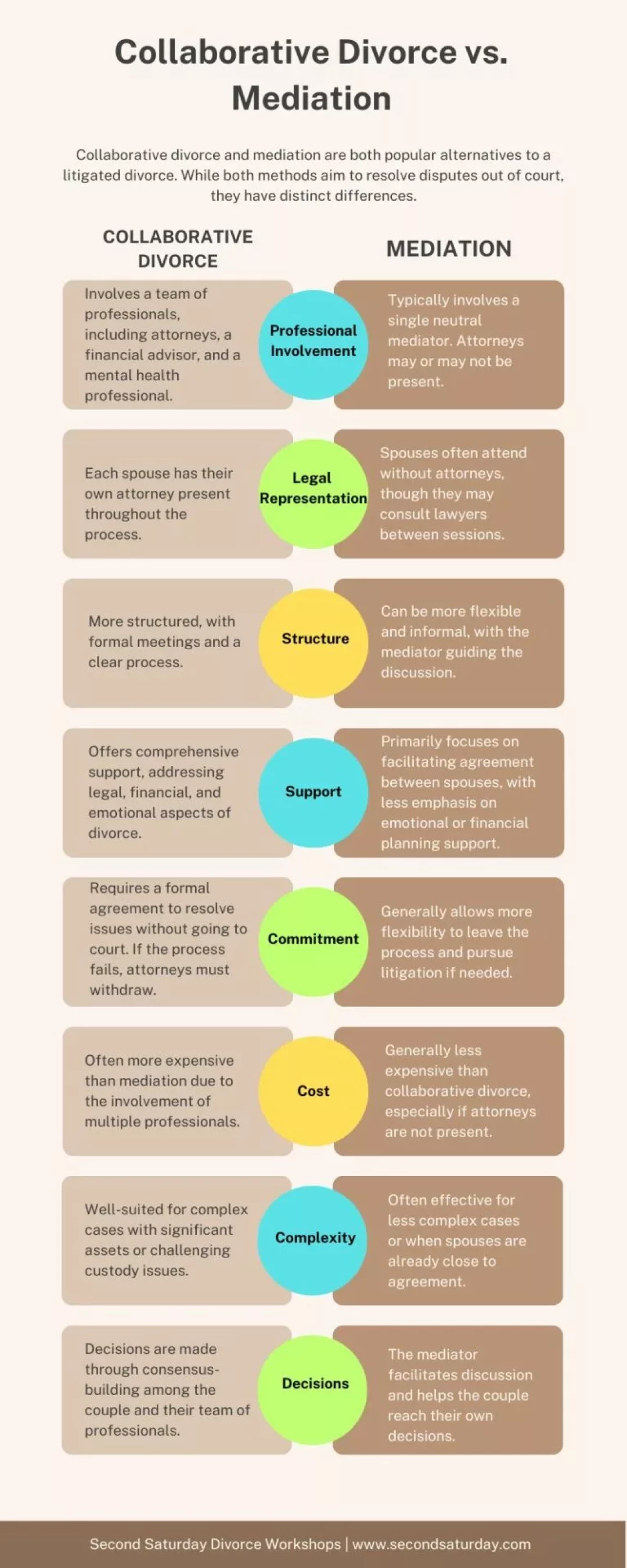
Collaborative Divorce vs. Mediation Infographic
Take the Next Step
If you’re considering a collaborative divorce, attending a Second Saturday Divorce Workshop can provide valuable insights and resources. Our expert-led workshops offer comprehensive information on all aspects of divorce, including collaborative options.
Find a Second Saturday Divorce Workshop near you.
FAQs About Collaborative Divorce
Q: What is collaborative divorce?
A: Collaborative divorce is a non-adversarial process where couples work with a team of professionals to resolve disputes and reach a settlement without going to court, focusing on mutual respect and problem-solving.
Q: How long does a collaborative divorce take?
A: Collaborative divorces typically take 4-8 months, often faster than litigated divorces. The exact duration depends on the complexity of the case and the couple’s ability to reach agreements.
Q: Is collaborative divorce cheaper than going to court?
A: Yes, collaborative divorce is often less expensive than litigation. Couples save money by avoiding court fees, sharing the cost of neutral professionals, and resolving issues more efficiently.
Q: What happens if we can’t reach an agreement in collaborative divorce?
A: If the collaborative process fails, both spouses must hire new attorneys and start the traditional court process. This incentivizes all parties to work toward a successful resolution.
Q: Can we go to court during a collaborative divorce?
A: No, the collaborative process requires signing a “no court” agreement. If court becomes necessary, the collaborative process ends, and you must start over with new attorneys.
Q: Is a collaborative divorce agreement legally binding?
A: Yes, once a collaborative divorce agreement is reached and signed by both parties, it becomes a legally binding document, just like a court-ordered divorce decree.
Q: Who are the professionals involved in a collaborative divorce?
A: A collaborative divorce team typically includes attorneys for each spouse, a financial neutral, a divorce coach (mental health professional), and sometimes a child specialist or other experts as needed.
Q: Is collaborative divorce suitable for high-conflict couples?
A: While challenging, collaborative divorce can work for high-conflict couples if both parties are committed to the process and willing to work with the professional team to manage conflicts constructively.
ICFT Counselor Perspective
Collaborative divorce is a lesser-known option for many couples moving down the path of ending their marriage. While it isn’t a fit for everyone, it can be an extremely helpful alternative for those who are hoping to do so a bit removed from the legal system.
Collaborative divorce can possibly save costs, reach resolution more quickly, reduce emotional stress, allow for greater input/control over the outcome & preserve the co-parenting relationship.
I strongly believe that all couples on the path of ending their marriage should at least familiarize themselves with this possible course of action. This article will help you determine whether or not it seems to be a fit for you. Read on for helpful things to consider as you make your decision!
- Amanda Callen, MA, MFT